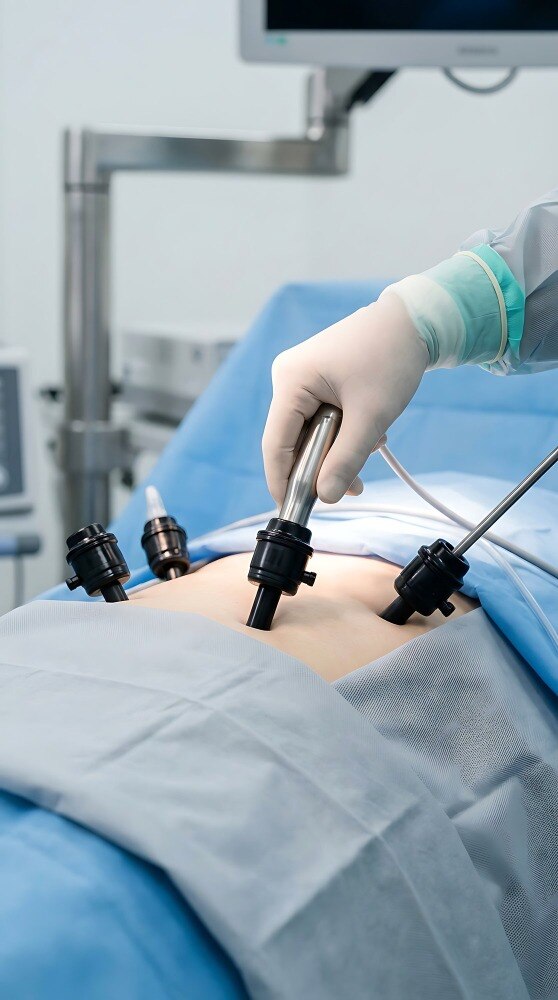
Recovery depends on the operation performed, not only on the size of the skin incisions. Use the timeline, symptom guide and activity checkpoints below to plan your first days at home, recognise expected changes and know when to contact your surgical team.
Key takeaways
- Walk briefly and often, while increasing activity gradually.
- Keep incisions clean and dry; follow your surgeon’s dressing instructions.
- Do not drive while taking opioid pain medicine or until you can brake safely.
- Seek help for fever, worsening pain, repeated vomiting or spreading redness.
What recovery looks like from discharge through the first month
The first 24 hours after discharge are usually the slowest. Anaesthesia, carbon-dioxide gas and pain medicines can leave you sleepy, bloated, constipated or mildly nauseated, even when the small incisions look fine.
Your laparoscopic surgery recovery timeline will usually follow this pattern:
- Days 1–2: Rest between short, gentle walks around your home. Expect abdominal soreness, port-site tenderness and fatigue. Shoulder-tip pain from the gas can occur. Have an adult nearby if you still feel drowsy.
- Days 3–4: Movement should become easier, but energy often remains limited. Increase walking gradually rather than testing your fitness. Bruising or a small amount of clear drainage at a port site can occur.
- Days 5–7: During the first week after laparoscopic surgery, many people manage basic washing, dressing and light meals. You may still need daytime rests and have discomfort when coughing or getting out of bed.
- Weeks 2–4: Recovery after discharge continues unevenly. After uncomplicated gallbladder surgery, ordinary activities often return within one to two weeks; bowel surgery, emergency surgery or an operation converted to open surgery takes longer.
By the first month after surgery, many patients feel close to normal, but strenuous activity and tiredness can lag behind. Your operation, not just the incision size, sets the timetable. Seek urgent medical advice for sudden severe pain, fainting, heavy bleeding or rapidly worsening symptoms.
Managing pain, fatigue, nausea and the first daily tasks
Keep the first day at home quiet, but do not stay in bed continuously. Abdominal soreness after laparoscopy and tenderness around the small incisions are common; use the pain relief prescribed for you and change position slowly.
Shoulder-tip pain from carbon dioxide is referred pain caused by irritation beneath the diaphragm, not an injured shoulder. Walk gently, sit upright, and change position to help the gas disperse; contact your surgical team if the pain is severe or persists.
Fatigue can make simple tasks feel demanding during the first week, so divide them into short efforts with rests between them. Nausea often settles as the anaesthetic wears off; stop and seek advice if you cannot keep fluids down or vomiting continues.
- Take a short walk around your home several times daily, increasing distance only when you feel steady.
- For stairs after laparoscopic surgery, use the handrail, take one step at a time, and have someone nearby the first time.
- Avoid lifting, rushing, and strenuous exercise; stop if pain, dizziness, breathlessness, or unusual weakness develops.
- Ask someone else to handle bathing children, shopping, or household jobs that require bending or carrying.
Seek urgent medical assessment for sudden severe abdominal pain, fainting, heavy bleeding, chest pain, breathlessness, fever, or a painful swollen calf. Worsening rather than improving symptoms need attention instead of waiting for a routine review.
Food, medicines and incision care at home
After an uncomplicated operation, advance your diet after laparoscopic surgery as your appetite returns. Start with water, oral rehydration fluid, soup, toast or rice, then add small portions of protein, fruit and vegetables. After bowel resection, follow the surgeon’s temporary diet plan; diarrhea, urgency or food intolerance can change what you tolerate.
- Take paracetamol after surgery exactly as directed, and check cold or combination medicines so you do not take paracetamol twice.
- Use an opioid only when prescribed and needed for stronger pain. Do not drive, drink alcohol or combine it with sedatives while taking one.
- For opioid constipation prevention, drink fluids, walk gently and use the laxative your surgical team recommends. Treat constipation after surgery early rather than straining.
- Take antibiotics only if prescribed and complete the course unless the prescriber tells you to stop.
- Keep each incision clean and dry, and shower only when your discharge instructions allow it. Do not soak in a bath or swimming pool until the wounds have sealed.
- Leave surgical glue, Steri-Strips and scabs in place; do not pull them off. Replace a dressing if it becomes wet or dirty, following the supplied instructions.
Check the wounds daily. Contact your surgical team for spreading redness, increasing warmth, pus, wound separation, fever, repeated vomiting or pain that is worsening instead of settling. Seek urgent help for heavy bleeding, severe abdominal swelling or inability to keep fluids down.
Driving, work, exercise, sex and lifting: when can you resume them?
You are ready to resume an activity when you can do it without worsening pain, dizziness, wound pulling or unusual fatigue.
The operation matters more than the size of the skin incisions: diagnostic laparoscopy and gallbladder removal often allow ordinary activities within 1–2 weeks, while bowel resection, cancer surgery, emergency surgery or an operation converted to open surgery usually takes longer.
Use these checks before restarting each activity:
- Driving after laparoscopic surgery: wait until you are off opioid pain medicine, can sit comfortably, turn your body and perform an emergency stop without pain. Check your insurance and surgeon’s instructions before driving.
- Return to work after surgery: desk work may be possible when you can concentrate and manage a full morning without needing to lie down. Physical work requires stronger movement, longer walking and specific clearance.
- Exercise after laparoscopy: walk early and increase distance gradually. Add cycling, swimming, running or weight training only when wounds are healed and movement causes no pain.
- Sex: resume when you feel comfortable and movement does not pull the incisions. Pelvic or bowel procedures may require a longer, operation-specific restriction.
- Lifting restrictions: follow the limit set for your repair rather than assuming small incisions make heavy lifting safe. Hernia repair and deep internal repairs need particular caution.
Dr Chirag Vaja can base activity advice on the organ treated, internal repair, wound healing and complications rather than applying one timetable to every laparoscopic procedure. A laser-assisted procedure also has no single recovery schedule; the treated tissue and technique determine when lifting, exercise and sex are safe.
Related services
Laparoscopic Surgery Laparoscopic Surgery (Gallbladder Stones,Appendix) Laparoscopic Surgery (Gallbladder Stones & Appendix) Laparoscopic surgery is a modern, minimally invasive surgical technique used to treat conditions... View service → |
Gastro-intestinal Surgery Gastro-intestinal (GI) surgery focuses on the diagnosis and surgical treatment of disorders affecting the digestive tract, including the esophagus,... View service → |
How recovery differs by operation—and which warning signs need help
The operation, not the size of the skin cuts, sets your recovery timetable. Infection, emergency surgery, open conversion, anaesthesia and your general health can extend it; robotic assistance does not automatically shorten it.
| Operation | Why recovery differs | What to expect |
|---|---|---|
| Gallbladder removal | Usually treats a contained problem without removing bowel | Recovery after laparoscopic gallbladder removal often reaches ordinary activities in 1–2 weeks, although fatigue and lifting restrictions can last longer. |
| Appendectomy | Infection and an abscess can slow healing | Recovery after laparoscopic appendectomy is shorter when the appendix has not ruptured; perforation can mean antibiotics, a longer stay and slower progress. |
| Hernia repair | The abdominal wall and repair itself need protection from strain | Hernia repair recovery focuses on gradually increasing walking while avoiding painful lifting; discomfort can persist around the mesh or sutures. |
| Bowel surgery | The bowel must reconnect and resume coordinated movement | Laparoscopic bowel surgery recovery is usually substantially longer, with temporary diarrhoea, constipation, urgency or food intolerance. A resection can also require a longer admission. |
Contact your surgical team urgently for increasing rather than improving pain, repeated vomiting, inability to keep fluids down, a swollen abdomen with no gas or stool, fever, pus or spreading redness at an incision, jaundice, or bleeding. Seek emergency care for breathlessness, chest pain, fainting, confusion, or one-sided calf swelling and pain.
A converted open operation generally lengthens recovery; it is a safety decision, not automatically a failure.
Frequently asked questions
How long does recovery take after laparoscopic surgery?
The first 24 hours are often the slowest. Many people resume basic daily tasks within days, but full recovery varies by operation and can take several weeks.
When can I drive after laparoscopic surgery?
Drive only when you are off opioid pain medicine, alert, and able to sit comfortably and make an emergency stop without pain.
When can I return to work and exercise?
Return when you can manage your duties without significant pain or fatigue. Increase walking gradually and wait for your surgeon’s advice before heavy lifting or strenuous exercise.
Which symptoms need medical help after laparoscopic surgery?
Contact your surgical team for fever, worsening or uncontrolled pain, repeated vomiting, increasing abdominal swelling, wound drainage, spreading redness, or difficulty breathing.
Related service
Hernia Surgery Hernia Surgery (Open & Laparoscopic) Hernia Surgery Hernia surgery is a safe and effective procedure to repair a weakness or opening in the abdominal wall through which internal tissue... View service → |