A robotic system can make difficult laparoscopic movements more controlled, but it does not make surgical decisions or remove ordinary operative risks. By the end, you will know how the system works, which features affect precision, when it may offer a practical advantage, and what to ask before choosing it.
Key takeaways
- The surgeon controls every robotic movement; the robot does not operate independently.
- Robotic instruments translate hand movements and provide wristed tool control inside the body.
- Compare incision size, recovery, risks and surgeon experience—not technology alone.
- Robotic precision cannot guarantee better outcomes or eliminate surgical risks.
What actually moves during robotic surgery?
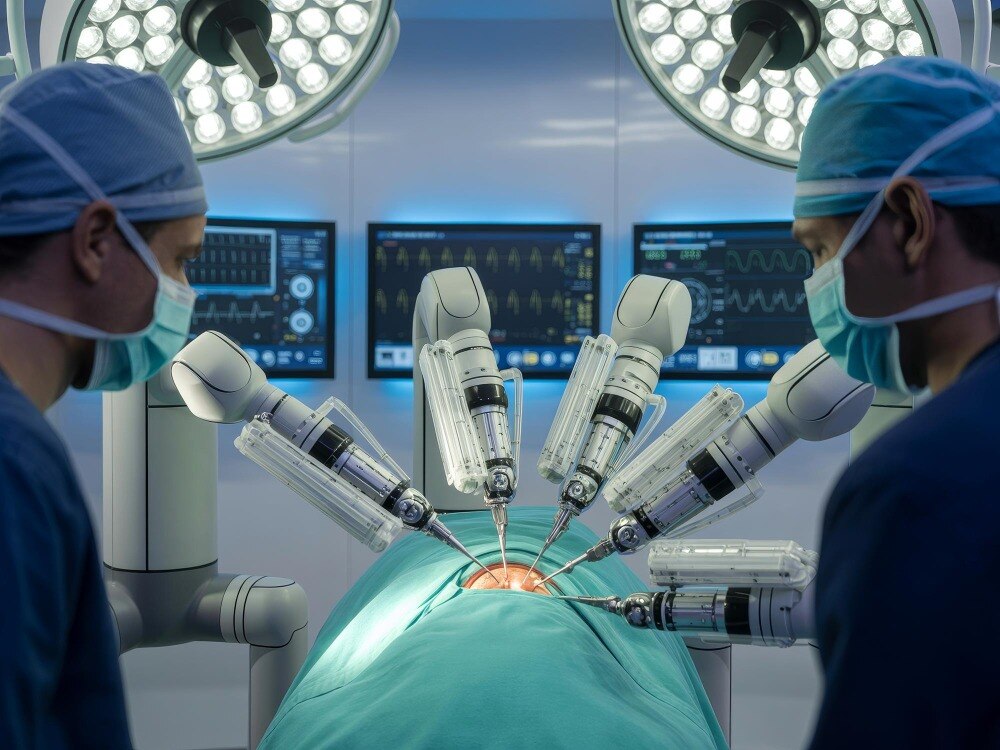
Your hands control the system; the robot does not operate on its own. From a surgeon console, the operator watches the operative field and moves hand controls. A surgeon-controlled telemanipulator uses hand-movement translation to send those commands to a camera and robotic instruments inserted through small ports.
Inside the body, the system can:
- Move wristed instruments in response to the surgeon’s hand movements, allowing controlled dissection, grasping and suturing.
- Scale a large hand movement into a smaller instrument movement and filter some hand tremor.
- Hold and reposition the camera steadily while the surgeon directs the instruments.
The external robotic arms move around the patient, while the instrument tips move inside the abdomen. The robot does not identify anatomy, decide where to cut, or apply force without the surgeon’s command. It also does not turn a risky dissection into a safe one automatically.
Many systems provide visual feedback rather than normal fingertip sensation. Surgeons judge tissue resistance through movement, tissue deformation and the magnified view, so excessive pressure can still injure bowel, blood vessels or surrounding structures.
The operation remains minimally invasive because it uses ports instead of a large incision; the robot itself does not determine that classification. If exposure, bleeding control, anatomy or equipment becomes unsuitable, the surgeon can continue with conventional laparoscopy or convert to open surgery.
Which robotic features improve technical control?
A magnified three-dimensional view gives the surgeon depth perception and a closer look at fine tissue planes, vessels and sutures. Stable camera control keeps the target centred instead of relying on an assistant to hold and reposition a laparoscope.
| Feature | Precision benefit | Where it matters |
|---|---|---|
| Magnified three-dimensional view | Shows depth and fine structures clearly | Dissection around vessels and deep pelvic anatomy |
| Wristed instruments | Bends and rotates at the tip | Intracorporeal suturing and knot tying |
| Articulated instruments | Reaches angles unavailable to straight laparoscopic tools | Work around corners and in confined spaces |
| Tremor filtration | Removes small involuntary hand movements | Fine dissection and needle placement |
| Motion scaling | Converts larger hand movements into smaller tip movements | Controlled movements near delicate structures |
Wristed instruments help place a needle at the correct angle, pass it through tissue, and retrieve it without repeatedly withdrawing the tool. Articulated instruments also let the surgeon work around organs and along narrow spaces where rigid laparoscopic instruments lose useful angles.
These controls improve movement, not judgement. The surgeon still identifies tissue, chooses the dissection plane and responds to bleeding. Poor port placement, limited exposure or unfamiliarity with the system can erase the technical advantage, and tremor filtration cannot prevent a deliberate movement in the wrong direction.
How does robotic surgery compare with laparoscopy and open surgery?
The main difference is how the surgeon reaches the target and controls instruments. Robotic surgery and conventional laparoscopy are forms of minimally invasive surgery using small access ports; open surgery uses a larger incision that exposes the operative field directly.
| Approach | Access and instrument movement | Visibility | Recovery and conversion |
|---|---|---|---|
| Robotic surgery | Small access ports; wristed instruments translate the surgeon’s console movements | Magnified three-dimensional view | Often less wound pain and faster recovery than open surgery; conversion remains possible |
| Conventional laparoscopy | Small access ports; long, rigid instruments move through fixed entry points | Camera magnification, usually with less depth perception than robotic systems | Often shorter recovery than open surgery; conversion remains possible |
| Open surgery | One larger incision; the surgeon handles instruments directly in the exposed field | Direct view and touch | More wound discomfort and a longer recovery; no conversion is needed because the operation already uses open access |
Robotic surgery still requires abdominal insufflation, port placement and patient positioning. Removing the specimen can also require an additional or larger incision, so “minimally invasive” does not mean incision-free.
The surgeon controls every robotic instrument movement; the system does not operate autonomously. Any approach can require open surgery conversion if bleeding, poor exposure, unexpected anatomy, equipment failure or inadequate progress makes a safer operation necessary.
Robotic assistance may improve reach in confined spaces, but it does not guarantee a shorter operation or a quicker recovery than laparoscopy.
When is robotic assistance a sensible fit for your operation?
A robotic approach is most sensible when the planned repair or resection is difficult to perform through straight laparoscopic instruments, yet still suitable for small-port access. The label “robotic” matters less than the anatomy, the target of surgery and the surgeon’s ability to obtain safe exposure.
Assess the operation against these questions:
- Is the target deep, narrow or surrounded by structures that demand fine dissection and suturing? This is why pelvic surgery, selected colorectal surgery and some upper gastro-intestinal surgery can benefit from articulated instruments and stable three-dimensional vision.
- Does the repair require precise reconstruction? A complex hernia surgery repair, intracorporeal suturing or a cancer resection near critical nerves may justify robotic assistance when conventional laparoscopy limits instrument angle or reach.
- Can the disease be removed safely through ports, with an extraction incision if needed? A large tumour, extensive adhesions or involvement of nearby organs can make another approach more appropriate.
- Does your anatomy allow safe port placement and positioning? Previous abdominal operations, unusual vessel location, severe obesity or the need for prolonged steep positioning can change the balance.
- Does the surgeon perform this operation regularly with the system? Experience, exposure and a clear plan for conversion to laparoscopy or open surgery matter more than the machine’s presence.
Dr Chirag Vaja can discuss these trade-offs across gastrointestinal, colorectal and hernia procedures rather than treating robotic assistance as an automatic upgrade. The decision should include bleeding, organ injury, infection, anaesthetic risk and the possibility that the operation takes longer or requires conversion.
What does robotic precision not guarantee?
Robotic precision does not guarantee a safer operation, faster recovery or better long-term results. The surgeon still faces bleeding, infection, injury to nearby organs, anaesthetic risk, trocar-site hernia and complications from prolonged steep positioning.
| Question | Evidence or practical point | What it means for your decision |
|---|---|---|
| Routine gallbladder removal | The RIVAL trial found no meaningful pain or quality-of-life advantage over laparoscopy; robotic surgery took longer and cost more. | Advanced technology is not automatically better for a straightforward operation. |
| Rectal cancer surgery | In ROLARR, median operating time was about 298 minutes with robotics versus 261 minutes with laparoscopy; overall conversion differences were not statistically significant. | Robotics does not guarantee a shorter operation or prevent open surgery. |
| Cancer surgery generally | Evidence for lower recurrence varies by procedure, and robotic assistance does not replace complete tumour removal and sound oncological technique. | Judge outcomes by the operation and disease, not the platform label. |
You still need to compare the proposed procedure, the surgeon’s experience with it, hospital support and the available laparoscopic or open alternatives. Conversion can become necessary when exposure is poor, bleeding is difficult to control, anatomy differs from scans or equipment fails.
Ask specifically:
- What benefit does robotics add for this operation?
- How often does the surgeon perform this procedure robotically and laparoscopically?
- What is the plan if conversion is needed?
- Does a laser have a separate role, and how will its heat be controlled to avoid unintended tissue injury?
Frequently asked questions
What actually moves during robotic surgery?
The surgeon moves hand controls at a console. A telemanipulator translates those commands to a camera and instruments inserted through small ports.
Which robotic features improve technical control?
Wristed instruments, movement scaling, tremor filtering and a magnified three-dimensional view can improve control in confined spaces.
How does robotic surgery compare with laparoscopy and open surgery?
Robotic and laparoscopic surgery use small ports, while open surgery uses a larger incision. Robotic systems add articulated instruments and console control, but outcomes depend on the operation and surgeon.
When is robotic assistance a sensible fit for your operation?
It can suit procedures requiring precise dissection, suturing or access to a confined area when the surgeon has appropriate training and the hospital has suitable equipment.
What does robotic precision not guarantee?
It does not guarantee fewer complications, faster recovery, lower cost or a better result. Patient factors, the procedure and surgical judgement still determine outcomes.